Thursday, June 21
During our last full day in Germany we met at the Hofbrau House for a traditional German breakfast. After breakfast Milaena, Katharina, and I discussed possibilities for future exchanges. We included what worked well and possible changes we could possibly make. Overall, everyone agreed the American-German student exchange is a very powerful educational tool to understand our world better. Doors are opened and barriers broken. Hugs were given and some tears shed by students as they said farewell. For me, I felt “See you later.” Katharina is the perfect, considerate host.


After our farewell, we took the train to the Dachau Concentration Camp. The camp was the first established concentration camp in 1933 to house political prisoners, Jews, Catholic priests, foreign nationals that Germany invaded, and criminals. Inmates were beaten, persecuted, starved, and suffered brutal treatment. No mercy was given to prisoners, because tolerance meant weakness. Almost 32,000 documented deaths occurred. However, not all deaths were documented. Over 200,000 prisoners were sent to Dachau. Throughout Dachau several memorials were placed to serve as reminders of the attrocities that occurred.


Wednesday, June 20
The students, Milaena and I went on a bike tour of Munich. We hopped on classic bicycles throughout Munich. During our four hour tour we learned about Munich’s beer, culture and history. We explored the Max-Joseph-Platz. Also we stopped Near the Max-Joseph Platz we learned about a little alley paved with trail of bronzed paved bricks commemorating the brave Germans who refused to salute Hitler. Hitler required everyone to salute to the Feldherrnhalle. Not everyone supported Hitler or the Nazi party and as an act of passive resistance, the opposers would take an alternative route using the Viscadigasses alley. The road became known as Dreuckebergasse, or “Shirker’s Alley.”
We were able to enter the Theatine Church, an all white interior with a peaceful atmosphere from the Baroque period.
We stopped in the Chinese Tower beer garden in the English Garden, where a band played and we enjoyed a traditional German lunch.
Later we walked through the Ludwig Maximillian University. There we located a powerful reminder of a group of student rebels led by siblings Hans and Sophie Scholl, who practiced non-violent resistance and were executed by Nazi authorities. Embedded into cobblestone pavement were replicas of the White Rose leaflets scattered on the sidewalk. The square in which the memorial is named is called the Geschwister-Scholl-Platz, or Scholl Siblings Square. Although the square is rarely visited by tourists, the memorial serves as an inspiring, yet chilling, reminder of the division during the Third Reich movement.


Tuesday, June 19,
After saying good bye to Christian, Milaena, Katharina, and I headed for Theodore Heuss Schule to meet up with the students. Through tears, the students hugged and said good bye. The American and German students experienced wonderful home stays. We loaded a coach bus and headed for Zugspitze, the highest peak in Germany.
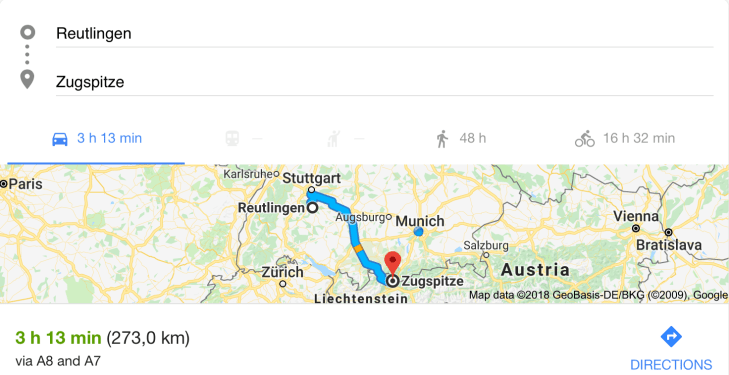
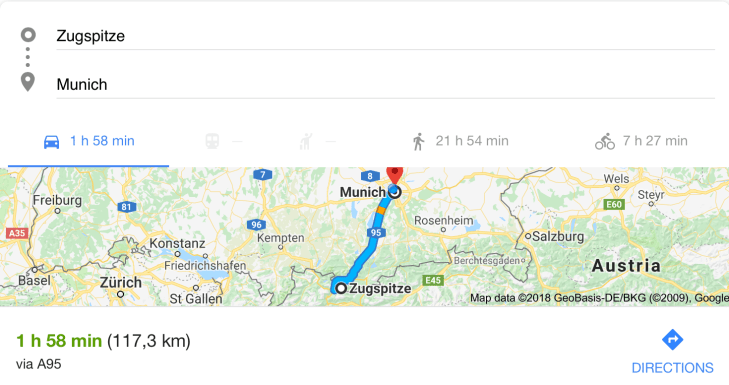
At Zugspitze we took a cog rail towards the top. There the students went sledding on the snow near the glacier. Although cloudy, the students loved seeing climbers, dogs (that took the same transport as the students), and having a snack at the top. At the base of the mountain, some students waded in the mountain water or went for a swim.


From Zugspitze we continued by coach to Munich. The students settled into the hostel, ate dinner and began exploring Munich.
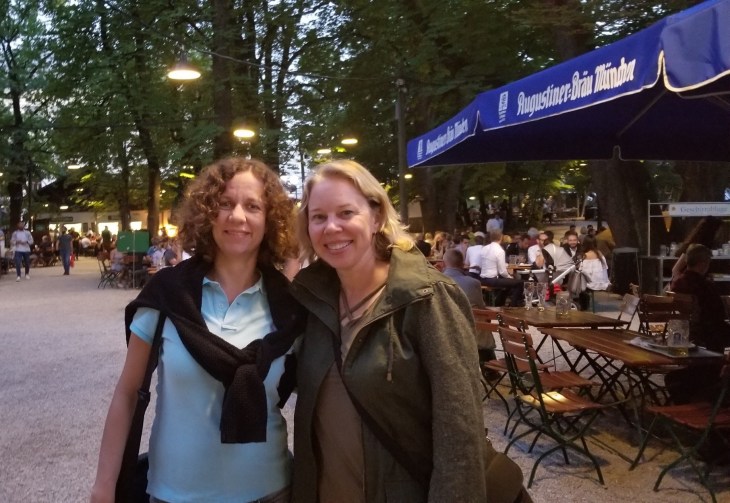
Kathatina took Milaena and I to one of her favorite beer gardens, the Augustiner.
Monday, June 18
This morning we visited Mischa’s English class. All of the students have previously graduated and have been employed. All of them were working towards there Bachelor’s degree at Theodor-Heuss Schule. Many would soon be going to England for an internship. Most of the students were between 22 and 26 years of age. All of the students were engaged in learning and increasing their English skills.
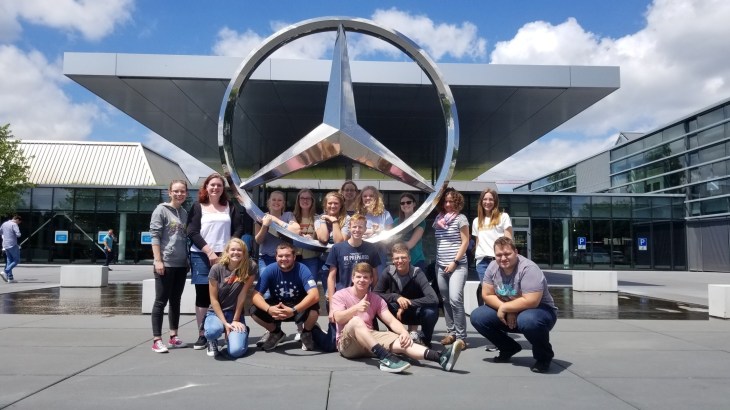
Later in the afternoon we traveled by tour bus to Rittersport where we toured the museum and purchased chocolate. After the tour we visited the Mercedes factory. I was amazed by the efficiciency of the plant. The students are gathered in front of the Mercedes center prior to the tour.

This evening I went out to dinner with Katherina and Christian at their favorite Greek restaurant. The company and food were delightful.
Sunday, June 17
This morning we said farewell to Katharina’s mother, Birgit in I hope to visit her again one day; she was so kind and very welcoming. Birgit suggested that we stop at the Viamala Gorge on the way to Lugano. Glacial ice and water from the Rhine cut through massive cliffs of the gorge over thousands of years.


Saturday, June 16
Birgit showcased her area with a tour of Val Lumnezia, the Valley of light. The valley stretches from Ilanz to the south and provided beautiful panoramic views of the sunny alpine valley. Villages along the way included Cumbel, Morrisen, Vella, Degen, Vattiz, Vignon, Lumbrein, and Vrin. We walked to the bathing lake Davos Munts, where children and families enjoyed the alpine water. We drove to the farthest village, Vrin where we ate a fantastic picnic lunch, packed by Birgit. Over thirty churches were an outstanding feature of the valley. One noticeable feature of Vrin was the mortuary by the Vrin church, which allows the inhabitants of Vrin to continue with their traditional way of taking leave with the deceased.
Friday, June 15
We visited Misha’s English class today. Many of the students varied from joining the military to finishing up their apprenticeships. Students were asked to discuss what they could do to reduce their personal carbon footprint and what would they like learn about another country in English.
After the class we traveled from Reutlingen to Schluein, Switzerland. In Schluein we met Katharina’s mother, Birgit. We stayed at her lovely home and walked through her village in the evening.


Thursday, June 14
We took the train from Reutlingen to Ulm, changing trains in Plochingen.
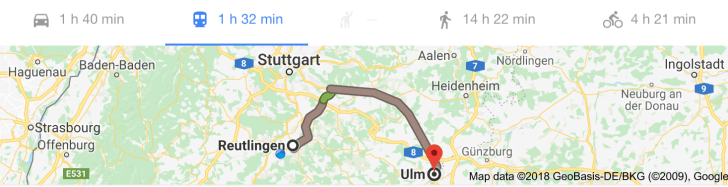
Leaving the train station we immediately headed to Fischer Viertel along the Danube River. The Fisherman’s quarter, built around the channels of the Blau stream which leads to the Danube, used to be the center of medieval Ulm. The quarter was known for the fisherman, tanners or shipbuilders. The Schief Haus (crooked house) were famous buildings in the district.


Before entering the church the students tried to capture the entire view of the church. Since the Ulm Minster is the tallest church in the world, we had difficulty capturing the entire view of the church. Eager to walk up the 768 steps of the Ulm Minster, we began the long spiral of stairs, becoming very narrow at the very top.


Wednesday, June 13
Prior to early morning shopping, we stopped at the Gomaringer Castle in Gromarenger. .


We purchased rhubarb and stopped at a local farm to purchase some strawberries. Milaena and I prepared three pies for a gathering this evening.


This year we were able to learn how to make pretzels with one of the Wildbakers, Jorg Schmid. As a fourth generation master baker, Jorg shared his skills and humor with the group of students. He is highlighted on German television and known for his baking show.


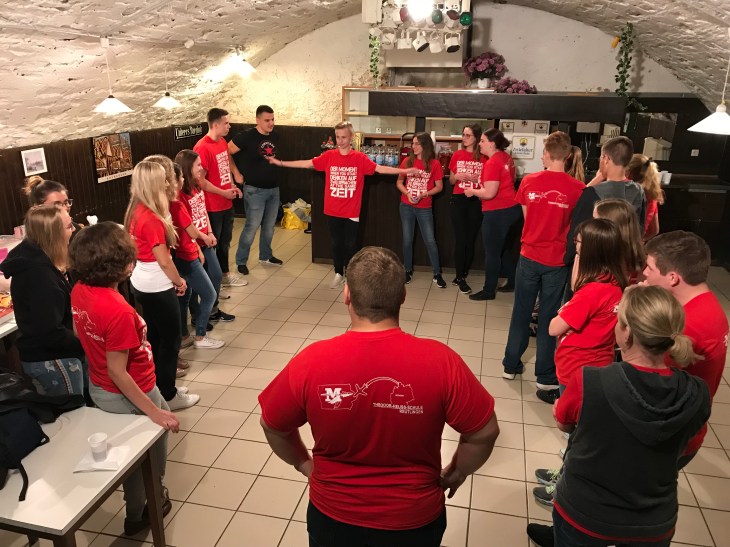
The German and American exchange students met at the Haus der Jugend (youth house) in Reutlingen. The students played sharades – the American students guessed German words, speaking only in German or acting out, while the German students guessed or acted out words in only English. After the game, we shared favorite party foods.

Tuesday, June 12
This morning Milaena, Katharina, and I met with Gertrud Gerstlauer, the head of the advanced education department at Theodor-Heuss Schule. Mrs. Gerstlauer took great interest in our exchange program and we discussed several topics. Information was shared in regard to both school systems. German students are able to differentiate what they would like to study earlier, unlike American schools – where students often wait until they are upper classmen in high school or even into college. Both schools systems indicated a strong need for an increase in workforce in the trades.
All of us shared that our students often ask, “When will I ever use this again.” Mrs. Gerstlauer’s beautiful antidote: “That’s not for me to tell you, but life will show you.” In both systems students are often motivated by grades rather than intrinsic learning. For example students often ask, “Will I be graded on this?”
We agreed upon the need for students to understand what is going on in the world, and desired that our students read more news. Milaena and I noticed that the German students seemed to have a broader understanding of current events and ethical issues. In an honest reflection, Mrs. Gerstlauer stated that we observed students who achieved the highest level and were going to graduate soon. These students were very engaged, and took great interest in American culture.
After our meeting, Milaena and I walked to the market downtown. We were excited that we were able to successfully pick out, weigh, and purchase spargel (white asparagus) from a Schwabian German with a heavy accent.
We later met up at Sybille’s home. We met her husband and reunited with her son Paul. Paul traveled with Sybille last fall during the exchange visit. We helped prepare the Spargel together.
Monday, June 11
The students, Milaena, and I attended the Theodor-Heuss Schule. While the students arrived with their host student, Milaena and I took the bus and walked to school. We walked up to the teacher’s lounge and greeted Sybille, an English teacher. Sybille had visited us last fall in the exchange with Katharina.
We were asked to attend two classes this morning. The first class was an international economics class taught by Heike. As we seated ourselves in the classroom, some of the young males behind me asked in German how much German I understood. I answered, “Ich verstehe ein bischen Deutsch.” Their reaction was priceless. As the students completed the lesson, I enjoyed watching the student-teacher interactions. Later in the lesson, students wanted to know why students would study German, to what level do they learn German, or how common is if for students to learn German in America. The students were also interested in American politics and other cultural aspects. Several students suggested that they would like to possibly participate in an exchange in the future.
One noticeable difference is the student and teacher schedules. The students do not meet with the teachers each day. More emphasis is placed on teacher preparation for their classes rather than student contact time. The students often meet for 90 minute blocks with 15 minutes between each block. We noticed that the German instructors were often discussing their lessons and preparations. The class stays together and the teachers come to the students. The students are often grouped by subject interest, whether a language or economics. As a result students can meet for class trips or study trips. The students collaborate more and form a strong network.
Milaena and I also visited a debate class taught in English by Sybille and Ushi. The students were able to debate and speak in a second language amazingly well. We were asked about politics and asked what we thought of the political climate. We explained that we had observed noticeable differences since the 2016 election both nationally, statewide, and even locally. Students were particularly questioning gun safety. The German students overwhelmingly did not understand the need to increase the number of guns to control gun safety. They asked if we felt safe, and if we were comfortable taking guns to school. We discussed hunting and the second amendment and the rights of individuals. We discussed some stereotypes and students wanted to know more about American schools and the students.
We were fortunate to have a student who had previously attended our high school for several weeks. He explained his love of the vastness of the United States, and completely enjoyed his experience.
In a final question one student asked, “What is your dream for America?” I responded with a rhetorical question, “Do you want to know my dream for America, or my dream for humanity?” Upon hearing the ahas in the room, I responded that I hoped that we could one day come together as a global community and work for common goals for the betterment of all people.
After lunch, we took the train to Tubingen. There we rode the Stocherkahn (punting boats) along the Neckar River. Many of our students, including myself, were able to practice our boating skills.


Sunday, June 10
Milaena and I were so elated to once again see Katharina, our host. This is my third time staying with Katharina. Likewise, she has visited me three times.
Today we travel from Berlin to Reutlingen via train. We will connect with our host families for the week.


Saturday, June 9
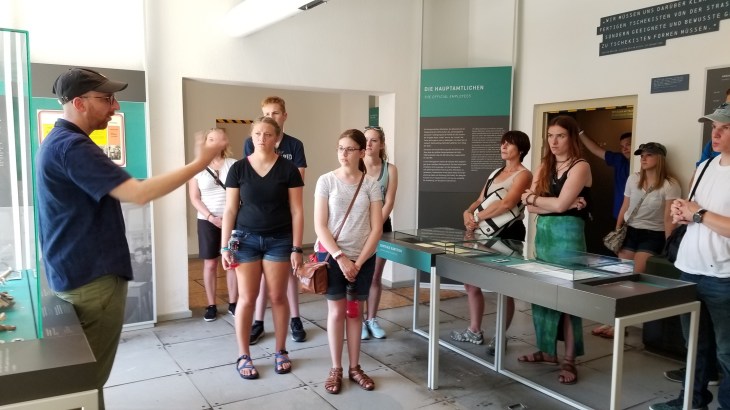
Meeting at the train station, we took the train and subway to the Stasi Museum in Berlin. After World War II the German communists, ruled by the Socialist Unity Party (SED), formed a dictatorship in the Soviet occupied regions of Germany. The SED ruled the population through force, threats, rewards, and privilege. The SED infiltrated all aspects of life, rewarding and reprimanding the people as needed. The students heard stories of a wife turning her husband for suspected plans of escape or a student saying a joke that a teacher found politically offensive. One particular descriptor summarized the time: “Wer ist wer”, or who is who –
“ In its constant effort to clarify ‘who is who’ the MFS – with is chekist forces, means and methods – has to identify people’s true political attitudes. Their ways of thinking and behaving (…) To clarify (…) means providing an answer to
- who is an enemy;
- who is taking on hostile and negative attitude;
- who is under the influence of hostile, negative and other forces and may become an enemy;
- who may succumb to enemy influences and allow himself to be exploited by the enemy;
- who has adopted a wavering position;
- and who can the party and state depend on and be reliably supported by.”
Erich Mielke, Speech at the Central Conference of April 3, 1981
Taking the subway back to the Alexanderplatz, some of the students shopped while Milaena, Devin and I went to the Pergamon Museum. The Pergamon museum houses some of the world’s most remarkable architectural structures from the Greek and Romans. Although we were unable to view the Pergamon alter (180 -160 BC), we were awed by the sculpures and art work from the time period.


On the way back to the Weld clock at Alexanderplatz, we stopped and ate crepes outside the Berlin Cathedral. The Berlin Cathedral was erected in 1905. The church was the court church of the Hollenzollern dynasty, the rulers of Prussia and later German emperors. The church has a monumental dome, beautiful statues and intricate gold features and elaborate mosaics. I was able to climb the steps to the top and walk around the top of the dome.


In the evening I met with Andrea and Selda from Theodor-Heuss Schule. We walked along the river, viewed people waltzing, and wandered through the Hackenshen Hoefe. On our stroll back we viewed the Brandenburg Gate in the evening. Some of the students were able to ride a conference bike through the area. Berlin at night is spectacular, thanks to my new friends Andrea and Selda.


Friday, June 8
I am convinced that hostels are the way to travel. The accommodations, although modest, are both conveniently located and provide a fun environment for the students.
We met at the Berlin Hauptbahnhof for a walking tour. After waiting 45 minutes, our walking tour guide did not show. Plan B involved a hop-on, hop-off bus tour of Berlin. Next we took the train to the Berlin Wall Memorial and the East Side Gallery. Later in the afternoon we climbed to the top of Reichstag Cupula.


Thursday, June 7
After arriving in Berlin around 11:00 am we met with our friends from Reutlingen, Germany. We took the bus (we felt like sardines vacuum-packed into a can) to the hostel. Once we settled into our rooms, we walked to the boat tour on the Spree River. Afterwards we walked to the Brandenburg Gate, the Jewish Memorial, entered the room of Silence, the Sinti and Roma Memorial. The students, Milaena and I were able to reflect upon the autrocities of the genocide that still affects so many today. Afterwards we ate dinner at the hostel.
Wednesday, June 6
Each of us drove to Chicago. The students were such fun to travel with to New York and then to Berlin.


Friday, June 1
Students and parents gathered at my home to make last minute preparations for our German tour. We have a great group of students from the high school traveling with us this year. 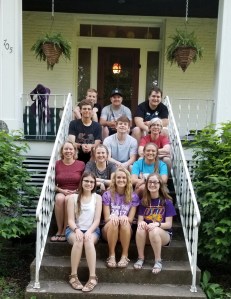
 Be Curious!