Hello, my name is Pam Joslyn and the title of my project was “Unleash the Design Process”. Antti Laherto, my advisor from the University of Helsinki, suggested that I participate in the classes in the STEP (Subject Teacher Education Program) program. The STEP program develops teachers’ pedagogical studies in English at the Department of Teacher Education. The goal of the STEP Project is to design and pilot a teacher education curriculum in English for subject teachers. Students enrolled in the classes were from the United States, Mexico, Turkey, Pakistan, Korea, Bulgaria, Chile, Namibia, China, Spain, South Korea, Netherlands, Norway, Japan, Greece, Finland, and France. By participating in the classes, I gained an evolving view of education from all over the world, and many of the students in the cohort were parents with children in the Finnish school system. Jari Saliminen, the instructor in the Social, Cultural and Philosophical Foundations of Education, emphasized the challenges between public reform discourse and the actuality of instruction. In his first lecture, Dr. Saliminen emphasized historical perspectives of education and its impact, and asked, “Where are we, where do we want to go, and how do we want to get there?” Amazingly, these questions have universal implications.
So, or “niin”… I wanted to begin with my own historical perspective. 
As a science teacher, I have encouraged students to engage in the inquiry process through a variety of scientific investigations, whether finding the spring constant in a toy frog, finding the relationship between distance and time of an engineered object rolling down an incline plane, or predicting where a water balloon will land after studying projectile motion.
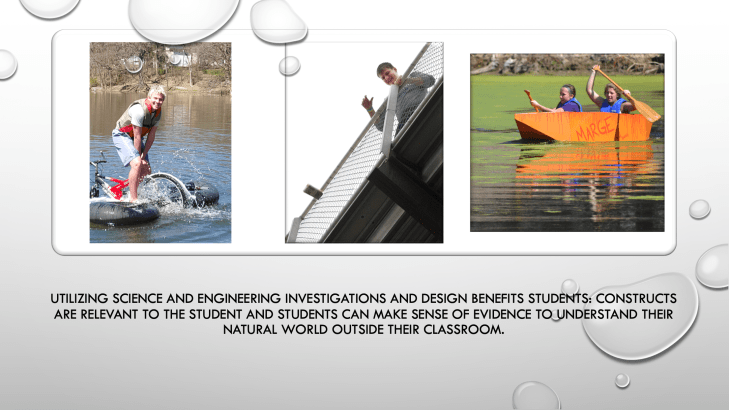
As the Next Generation Science Standards, NGSS, were adopted, I added more three-dimensional learning to provide meaningful constructs for my students whether designing a bike that travels across the pond while converting one form of energy to another, designing a cell phone case dropped from various heights after studying impulse and momentum, or designing a cardboard boat that can be paddled across the school pond.
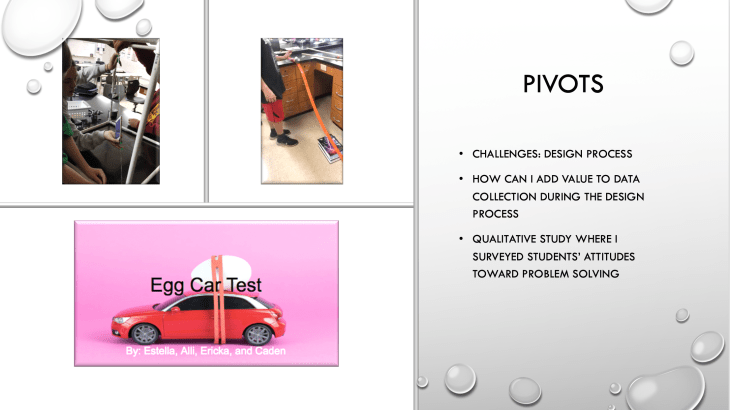
As I added more engineering facets in my performance assessments, I noticed that the students were engaged in the design process, but some students were not relying on content or data to drive the iterative process. So, I began to intentionally ask the students to collect data, whether in the design of security systems by measuring the angle of incidence and reflection, or measuring speeds in car crash tests. I found that student attitudes would shift during the design process, and students indicated the importance of data collection.
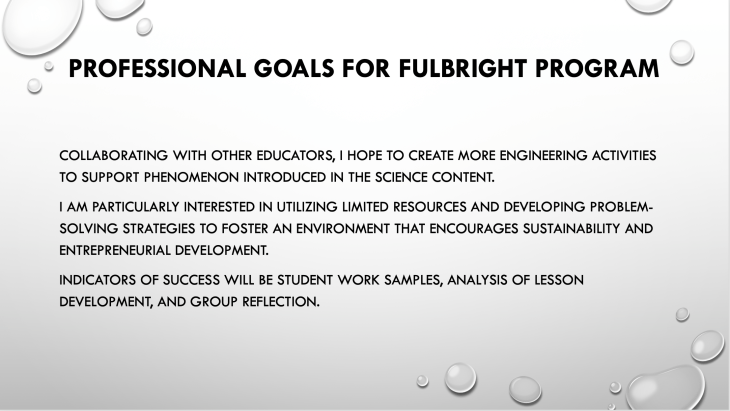
When I came to Finland, I wanted to collaborate with other educators and hopefully create more engineering activities to support phenomenon in the science content. Particularly, I wanted to promote problem-solving strategies that fostered an environment that encouraged sustainability and entrepreneurial development. Indicators of success would include student sample work, lesson development analysis or group reflections. 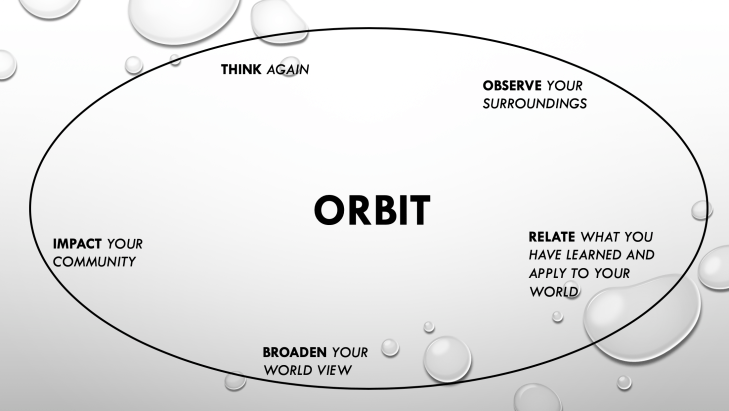
To help me obtain my goals, I felt it important to reflect upon my personal global perspective: to ORBIT (observe, relate, broaden, impact, think again).
- make observations
- relate what you learn and apply it to your immediate world
- broaden your world view from either another region or cultural perspective
- make an impact on your own community, or even globally
- reevaluate or think again about original ideas and mindfully consider the development of transformed ideas
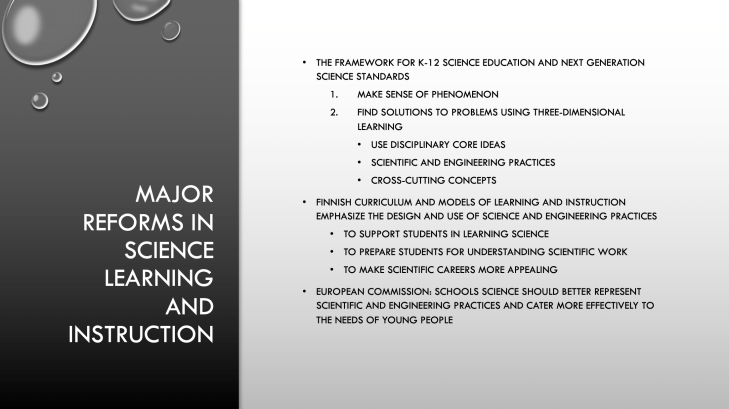
Within the first few weeks of my arrival I attended the U.S.-Finnish Seminar on Partnerships for International Research and Education (PIRE) “Learning Science Answering the Challenges for the Future of Science Education.” Dr. Barbara Schneider, from Michigan State University, shared data that indicated project-based learning, when implemented in physics and chemistry, increased student learning. Dr. Jari Lavonen, Professor of Physics and Chemistry Education, Department of Teacher Education, University of Helsinki, also shared data, indicating an increase in student engagement using problem-based learning. The theme of engagement was prevalent throughout the conference, where science teaching should better represent science and engineering practices and cater more effectively to the needs of young people.
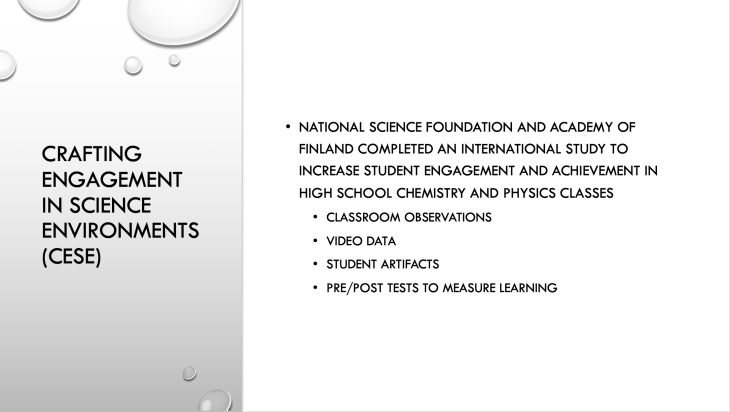
During the conference the partnership between the National Science Foundation and the Academy of Finland revealed a study to increase engagement and achievement in high school science and chemistry classes by using classroom observations, video data, student artifacts and pre/post tests to measure learning.
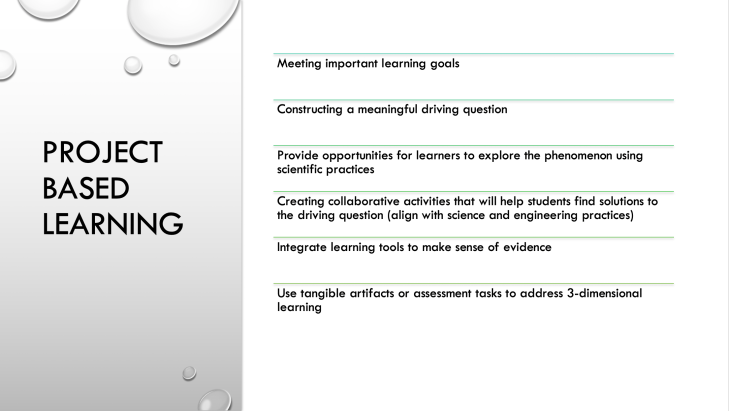
In addition to establishing criteria for problem-based learning, Stéphan Vincent-Lancrin, from the Centre for Educational Research and Innovation (CERI), provided eight criteria for good lessons. 1) Create students’ need/interest to learn; 2) Be challenging; 3) Develop clear technical knowledge in one domain or more; 4) Include the development of a “product;” 5) Have students co-design part of the product/solution or product; 6) Deal with problems that can be looked at with different perspectives; 7) Leave room for the unexpected; and 8) Include space and time for students to reflect and give/receive feedback.
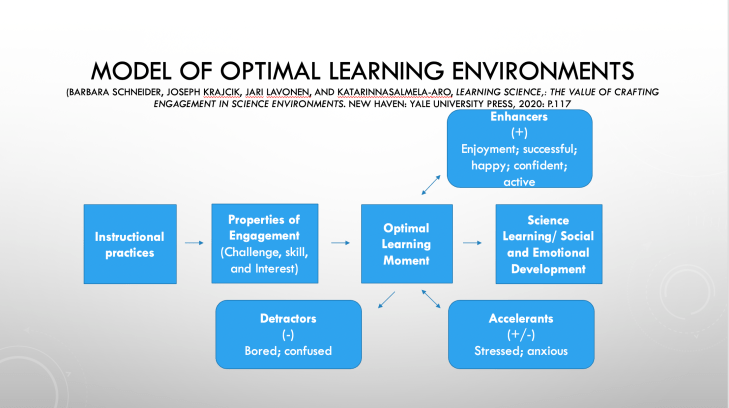
Of particular interest was a model for optimum learning environments, indicating the significance of detractors, accelerants, and enhancers during an optimal learning moment upon the completion of a challenge, skill or student interest.
During one of my favorite meetings on a trip to Tallin, Estonia, Dr. Jari Lavonen tied three themes together: widespread persuasion, new creative expertise, and continuous development of one’s knowledge and community. Widespread persuasion included knowledge of one’s field, pedagogical proficiency in substance science, research skills, different students, and social and ethical issues. New creative expertise comprised curriculum skills, the ability to innovate together and develop new innovations, and the ability to reflect, evaluate, and change one’s own actions. Continuous development of one’s own knowledge and community encompassed the ability to apply your own expertise and develop school skills in networks, and joint knowledge of community development.
Other topics of discussion covered how to integrate the UN 2030 sustainability goals within the curriculum. A factor that was discerning was that only 17% of 16 year-olds imagined themselves in a STEM-related career at the age of 30. Yet, many of these students scored well on PISA exams. Questions were raised as how to encourage young people to go into the sciences or even science teaching.
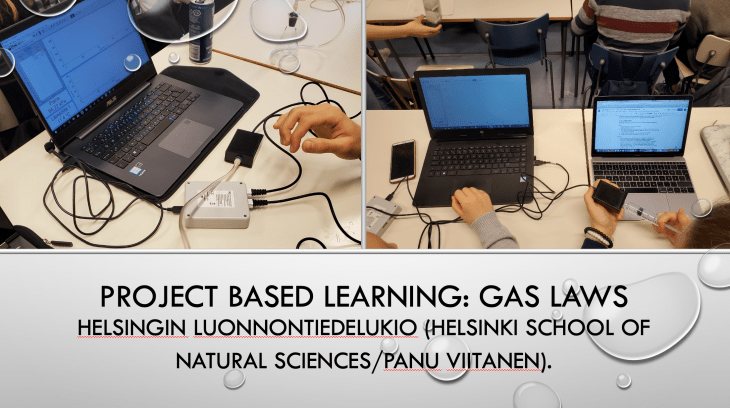
In order to gain an understanding of the project based learning in the Finnish classroom, I observed Panu Viiitanen’s class. Panu asked his students to complete a series of labs to describe the gas laws using Vernier equipment. The students were asked to relate temperature and pressure and volume and pressure. In the next lesson, the students were to draw the relationships and provide written descriptions of their observations. The models allowed predictions to be made, and the models provide accounts for observed phenomena. For example, Panu held a bottle outside, and the bottle collapsed. The students were required to draw a representation and provide an explanation for the event. Modeling builds on experiences and requires students to use, synthesize, and develop models to make predictions and show relationships between systems in the natural and designed world.

I asked Panu if we could develop an attitudes and approaches to problem solving survey that could be adapted for his class. He seemed very interested. Unfortunately, the schools were closed shortly after meeting, and we were unable to connect with the survey. Panu explained how he was teaching various modules remotely.
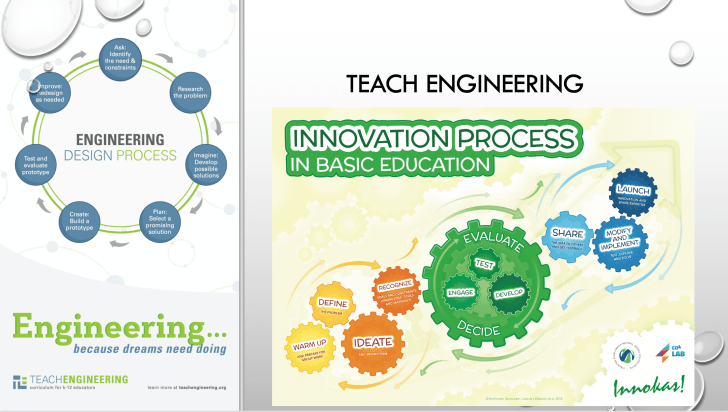
Although I observed inquiry and problem-based learning, I did not observe any engineering practices in the science classroom setting. I met with Leenu Juurola at the University of Helsinki, and I described my project interests with her, particularly the design process. She described the Innokas Network to me. The Innokas Network develops innovative education methods that support the learning of 21st century skills. The Faculty of Educational Science at the University of Helsinki coordinate the Innokas Network and conducts research with regional coordinators, schools, and partners. Collaborative partners include Stanford University and various companies. The research methodology is based primarily on design research, and the researchers collaborate closely with teachers, students, and school partners to identify school challenges and address innovative solutions to meet those challenges. Leenu and I discussed the intricacies of creating an environment that is conducive to the design process, such as creating a trusting culture where students can freely communicate their ideas. I wanted to share an example of the iterative process that was used by Teach Engineering so that the two processes could be compared. 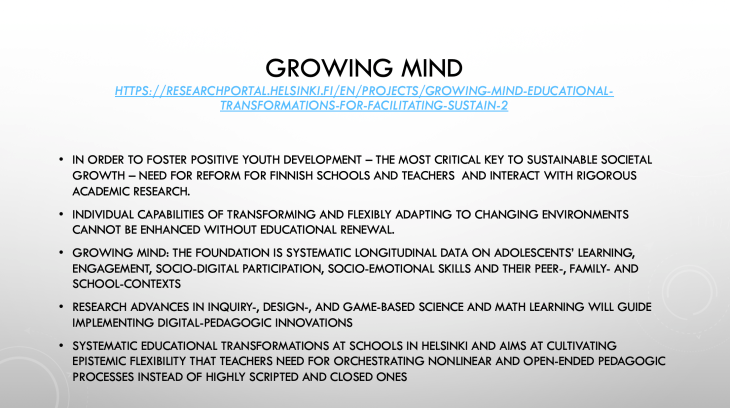 I also met with Laura Salo, a project designer from Innokas and coordinator from Growing Mind. Growing mind is a part of the Strategic Research Program of the Academy of Finland. The project coordinates Finnish teaching and instructional practice aligned with rigorous action-based academic research. The project focuses on the following six areas: 1) systematic longitudinal data on adolescent’s engagement and socio-digital participation, including neuroscientific studies of digital activity; 2) empowering learning and development; 3) implementation of engaging making and gaming projects at schools; 4) developing new generation learning analytics; 5) supporting teacher development and systemic school transformation; and 6) organizing multi-faceted research practice workshops.
After I met with Laura, schools began to shut down. I had intended observing schools participating in innovative and entrepreneurial projects.
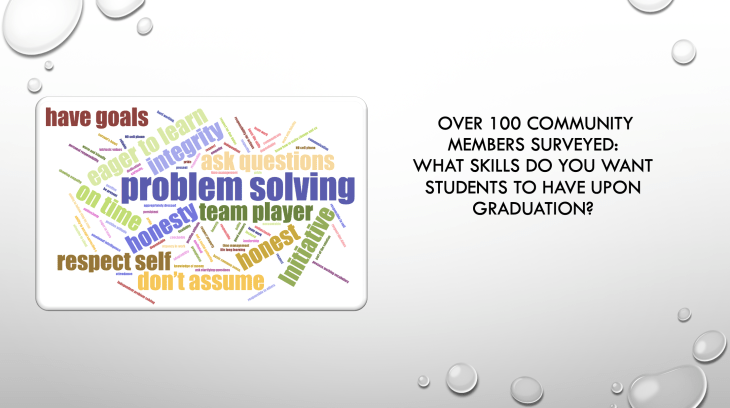
I had also wanted to find out what community members wanted from Finnish high school graduates. In my own community, I surveyed over 100 community members, and the largest focus was the ability for students to problem solve and think critically. 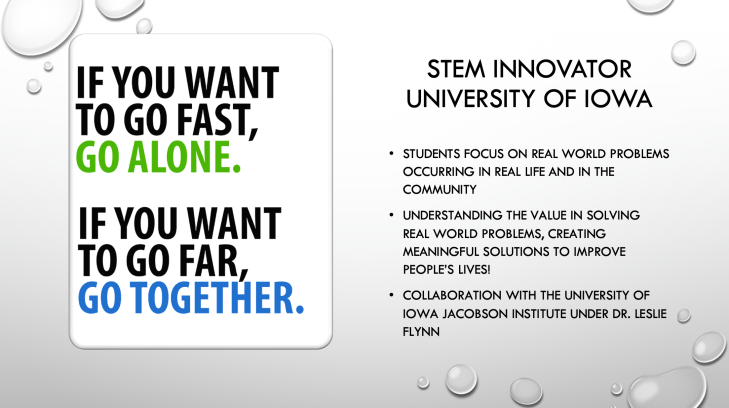
I envisioned entrepreneurial programs from the University of Iowa and Growing Minds, similarities, differences, partnerships, and possibilities.
The theme of Finland Fulbright is “Together Shaping the Future”. Together: we all have responsibilities to solve problems together. Shaping: proactively making a difference through creativity, education, and knowledge. Future: everything ultimately has a positive impact for everyone and future generations.
Although my time was cut short, I am encouraged by the words of William Fulbright, “The essence of intercultural education is the acquisition of empathy–the ability to see the world as others see it, and to allow for the possibility that others may see something we have failed to see, or may see it more accurately” (From The Price of Empire).
My view of problem-based learning has evolved since arriving in Finland. I look at learning through a new lens, and I am learning how ideas and innovations function in entirely unique systems.
During our orientation we were told Prime Minister’s Sanna Marin’s New Year’s message (December 31, 2019): “Finland’s strength lies in its people and their knowledge. We have survived because of our desire and ability to learn. We have risen from modest beginnings to become one of the most highly educated and skilled nations in the world. This was the secret of our success yesterday; this will remain the key to our success tomorrow. That is why we must have the courage to keep investing in people and knowledge. We must dare to create something new. In a rapidly changing world, simply reworking old recipes is not good enough.” We still have a lot to learn from Finland.
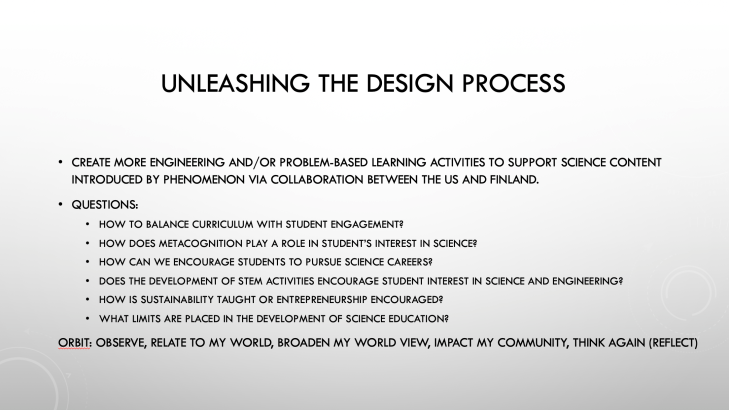
Niin, or so, my goal was to create more engineering/ and or problem-based learning activities to support science content introduced by a phenomenon. I hope to continue my collaborations with the outstanding Finnish educators that I have met. I still have questions that I want to pursue. Finally, I will continue on my ORBIT: observe, relate to my world, broaden my world view, impact my community, and think again.
Thank you Fulbright and Fulbright Finland.
 Be Curious!